Overview
For over fifteen years, the smartphone has been the center of our digital universe. It’s our communicator, camera, wallet, and window to the world. But the pace of innovation, once dizzying, has noticeably slowed. Each new model offers incremental upgrades, not the revolutionary leaps we once expected. This plateau has prompted the biggest names in the industry to ask a critical question: what comes next? Tech giants like Apple, Google, and Meta are now seriously investing in a future that isn’t tethered to the black rectangle in our pockets. They envision a future beyond smartphones, signaling a fundamental shift in how we will interact with technology. This isn’t about the death of the phone, but its evolution from the center of our lives to just one node in a larger, more intelligent ecosystem.
What “Future Beyond Smartphones” Really Means in 2025
The term “beyond smartphones” doesn’t imply that your iPhone or Android will vanish overnight. Instead, it describes a strategic shift away from device-centric technology toward experience-centric interactions. The focus is moving from the screen you hold to the intelligence and context that surrounds you.
In this next generation of computing, the device itself becomes less important than the seamless service it enables. The goal is to embed technology into our environment so it can anticipate our needs and act on them with minimal direct input. This marks a transition from a world where we consciously “use” a device to one where technology works for us in the background.
Smartphones vs Post-Smartphone Ecosystem
Think of it this way: today, if you want to find a recipe, you pull out your phone, unlock it, open an app, and type. In a post-smartphone ecosystem, you might simply ask your kitchen’s smart display or even your AI-powered glasses for a recipe, and the instructions appear overlaid on your countertop. The smartphone becomes one of many access points, not the sole gateway.
Why Tech Giants Are Actively Moving Away from Phone-First Thinking
The smartphone market has reached a saturation point. Nearly everyone in developed nations who wants a smartphone already has one. This reality, combined with a clear innovation ceiling, means growth is stagnating. Simply making a phone slightly faster or its camera a bit better is no longer enough to drive massive sales or excitement.
Furthermore, tech companies recognize the limitations of confining powerful AI to a small device. To be truly useful, AI needs more data and context than a phone can provide. This is why companies are exploring new revenue models built on services and entire ecosystems rather than just hardware sales.
- Apple is a prime example. While the iPhone remains its cash cow, the company is heavily investing in its Services division (Apple Music, iCloud, Fitness+) and pushing into spatial computing with the Vision Pro. This strategy diversifies revenue and locks users into its ecosystem.
- Google has declared itself an “AI-first” company. Its focus is on making AI ambient and helpful across all its products, from Search and Maps to its Pixel devices and smart home products.
- Meta continues its hardware experimentation with smart glasses and VR headsets, betting big on the metaverse as the next major computing platform.
AI Assistants Becoming the New Interface
In the post-smartphone era, AI assistants are poised to replace the grid of apps on our home screens. Instead of hunting for the right app to perform a task, you will simply state your intention to an AI agent. This new interaction model is built on a simple “Ask → Action → Result” loop.
Imagine telling your personal AI, “Book a table for two at that Italian place we like for 8 p.m. on Friday and add it to my calendar.” The AI handles the entire process—finding the restaurant, checking for availability, making the reservation, and creating the calendar event—without you ever opening an app.
These interactions will be driven by voice and context-aware cues. Your AI will know your location, your schedule, and your preferences, allowing it to act as a true digital chief of staff. We’re already seeing the early stages of this with always-on ambient AI in smart speakers and newer mobile devices.
- Pros: Radically faster task completion, more natural and intuitive interactions.
- Cons: Significant privacy concerns, potential for AI errors with real-world consequences.
AR Glasses & Spatial Computing as Smartphone Alternatives
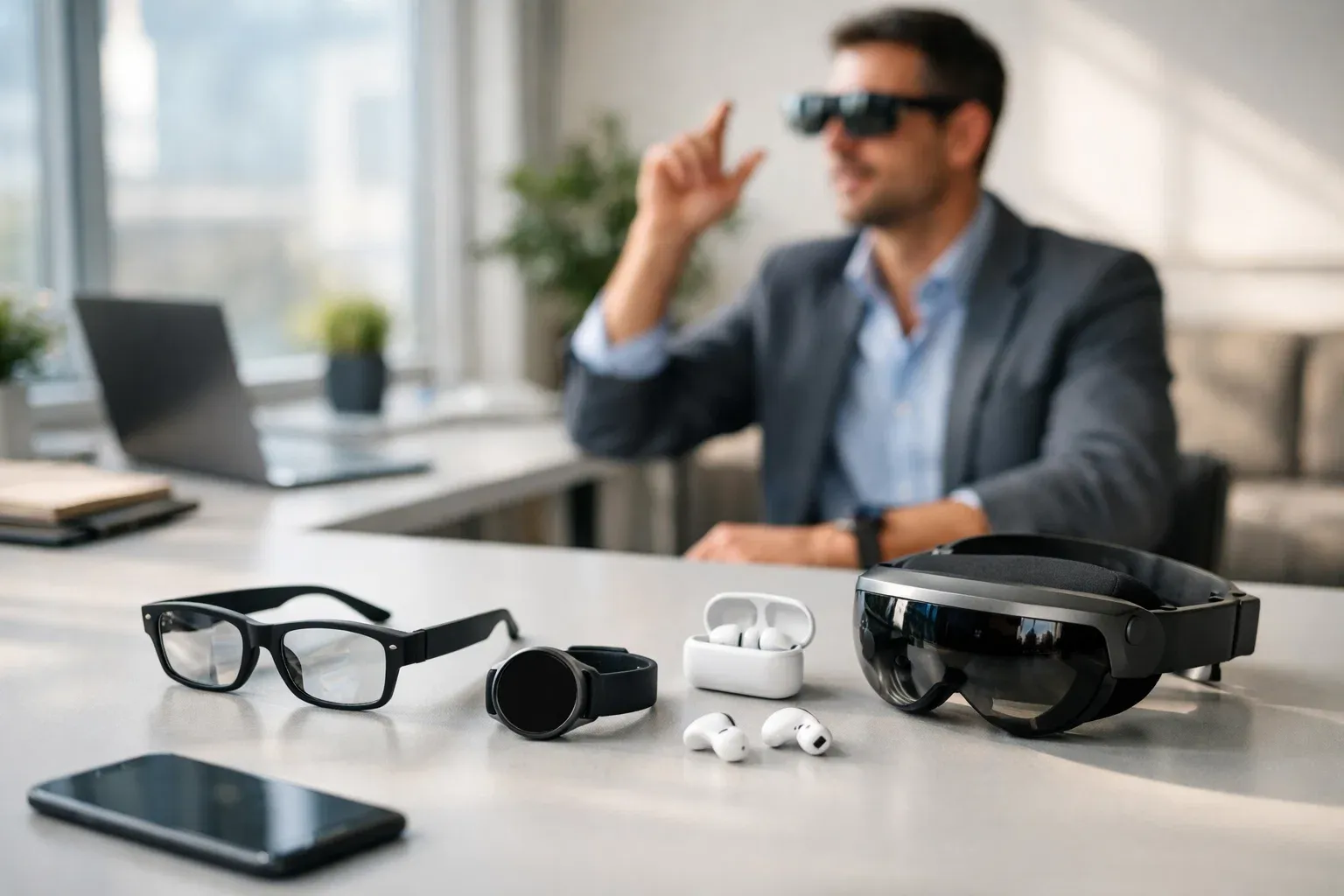
While AI provides the intelligence, augmented reality (AR) glasses and spatial computing hardware offer a new visual interface. These devices are designed to overlay digital information directly onto our view of the real world, creating a blended reality.
The potential use cases are vast. Imagine AR glasses providing turn-by-turn navigation arrows that appear on the actual road ahead of you. In a professional setting, a mechanic could see a schematic overlaid on an engine, or a surgeon could view a patient’s vitals without looking away from the operating table.
Apple’s Vision Pro is the most high-profile entry into this space, aiming to build a complete ecosystem for spatial computing. Meanwhile, Meta and Google continue to develop their own long-term visions for AR, believing it will eventually become a viable smartphone replacement.
AR Glasses vs Smartphones
| Feature | Smartphone | AR Glasses |
|---|---|---|
| Interface | 2D Touchscreen | 3D Spatial/Gestural |
| Interaction | Head-down, focused | Head-up, world-view |
| Information | Contained within the screen | Overlaid on reality |
| Immediacy | Requires taking it out of pocket | Always on, instantly available |
Wearables and Smart Devices Replacing Daily Phone Usage
The move away from the primary phone screen is already happening with the rise of wearables. Smartwatches, smart rings, and even AI-powered pins are taking on tasks that once required a phone.
These devices excel at health tracking, mobile payments, and delivering quick notifications. A smartwatch lets you check a message or track a workout without pulling out your phone, reducing screen time and digital friction. The appeal of a “less screen” future is powerful; it promises more presence in the physical world.
From a user’s perspective, this means technology becomes more specialized. Your watch handles health and notifications, your ring might handle payments and identity, and your phone is reserved for more intensive tasks like watching videos or writing long emails. Each device serves a purpose, contributing to a more distributed and less distracting tech experience.
Ambient Computing – Technology That Works in the Background
Ambient computing is the ultimate vision for many tech giants. This is a world where technology is so deeply integrated into our environment—our homes, cars, and offices—that it becomes invisible. The intelligence is all around us, working in the background to make our lives easier.
In a smart home, the lights, thermostat, and security system adjust automatically based on your presence and preferences. In your car, the navigation system preemptively suggests a different route to avoid traffic it detected on your usual commute. In this scenario, the smartphone is not gone, but its role is demoted. It becomes just one of many access points or a remote control for the intelligent environment, rather than the central hub it is today. This shift is a core tenet of the future beyond smartphones.
Brain-Computer Interfaces & Extreme Future Concepts
Looking further ahead, brain-computer interfaces (BCIs) represent a more radical vision for the future of interaction. BCIs aim to create a direct communication pathway between the human brain and a computer, potentially allowing us to control devices with our thoughts.
It’s crucial to separate the science from the hype. Currently, the most promising BCI applications are in medicine and accessibility. They offer hope for restoring movement to paralyzed individuals or enabling communication for those with severe motor neuron diseases.
However, the idea of a healthy consumer using a BCI to browse the web or send a message is still firmly in the realm of science fiction. The technical, ethical, and safety hurdles are immense. While companies like Neuralink are making progress, this is a long-term future, not a near-term smartphone replacement.
Are Smartphones Really Going Away? The Reality Check
Despite all this futuristic innovation, smartphones are not disappearing anytime soon. Consumer habits are deeply ingrained, and the global infrastructure is built around them. The cost of replacing billions of smartphones with new technologies like advanced AR glasses would be astronomical.
The most likely outcome is a hybrid future. For the next decade, the smartphone will likely coexist with this new wave of devices. It will remain the reliable “digital Swiss Army knife” we turn to for many tasks, while specialized wearables and ambient systems handle others. A complete transition will be gradual, driven by both technological maturity and a slow shift in consumer behavior.
Timeline – When Will This Shift Actually Happen?
Predicting the future is never exact, but we can project a realistic timeline based on current investment and development trends.
- 2025–2027 (Early Transition): This phase is already underway. We’ll see more sophisticated AI assistants, improved wearables, and second-generation spatial computers like the Apple Vision Pro. The smartphone remains dominant, but its role begins to be chipped away by these specialized devices.
- 2028–2032 (Mass Adoption): AR glasses could become smaller, cheaper, and more socially acceptable, leading to wider adoption. Ambient computing in homes and cars will become more common. During this period, some users may find they can go entire days without needing their phone for routine tasks.
- 2033+ (True Post-Smartphone Phase): If the technology proves itself, this could be the decade where the ecosystem of interconnected, intelligent devices finally unseats the smartphone as the primary personal computing device for a significant portion of the population.
Pros and Cons of a World Beyond Smartphones
This technological evolution brings both exciting possibilities and serious challenges.
Pros:
- Less screen addiction and more presence in the physical world.
- Faster, more frictionless interactions with technology.
- More personalized and context-aware digital assistance.
Cons:
- Massive privacy risks as more companies collect data on our environment and behavior.
- A steep learning curve for less tech-savvy populations.
- Accessibility and affordability issues that could widen the digital divide.
How This Shift Will Change Everyday Life
The transition to a post-smartphone world will reshape our daily routines.
- Work & Productivity: Workflows will become more seamless. Imagine a designer manipulating a 3D model with hand gestures or a remote worker feeling truly present in a virtual meeting space.
- Communication: Communication will become more immediate and contextual. Instead of texting, you might send a quick voice message through a wearable or share your point-of-view through AR glasses.
- Healthcare & Fitness: Continuous health monitoring via wearables and ambient sensors will move healthcare from reactive to proactive, alerting you and your doctor to potential issues before they become serious.
- Entertainment: Media will break free from the 2D screen. Gaming could happen in your living room with virtual characters, and movies could become truly immersive spatial experiences.
FAQs: People Also Ask
Will smartphones disappear completely?
No, smartphones are expected to remain but will share their role with new technologies like wearables and AR devices.
What will replace smartphones in the future?
AI assistants, AR glasses, and smart wearables are likely to take over many tasks currently done on phones.
When could we see life after smartphones?
Early changes are happening now, with bigger shifts possible in the next 5–10 years as new tech matures.
Are there any cons to a post-smartphone world?
Yes, concerns include privacy risks, learning curves, and accessibility for all users.
Conclusion
The era of smartphone dominance is not ending abruptly; it is evolving. The device that defined the last fifteen years is becoming a part of something bigger. The tech giants envision a future beyond smartphones that is more ambient, intelligent, and integrated into the fabric of our lives. This vision, driven by AI, AR, and a network of smart devices, promises a world where technology serves us more seamlessly. For users, the key is not to prepare for the death of the phone, but to anticipate its changing role. The next decade will be a gradual transition, a fascinating journey into the next generation of computing where our digital and physical worlds finally merge.
About the Author