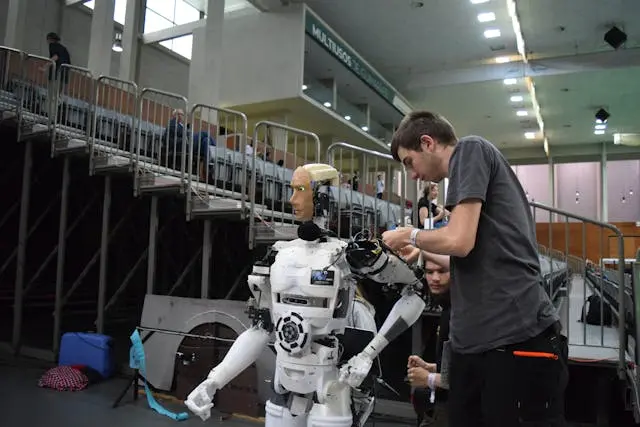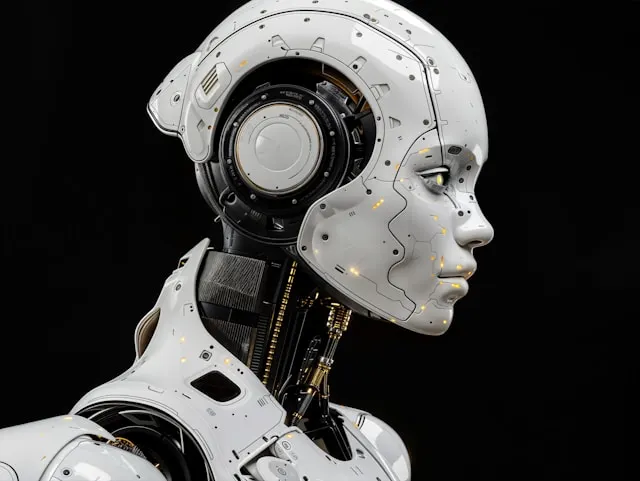

The World Economic Forum’s 2025 Future of Jobs Report estimates that shifting trends in technology, demographics, and the green economy will create 170 million new jobs by 2030 while displacing 92 million — a net gain of 78 million positions worldwide. That single data point reframes the entire debate about whether robots will replace humans. The answer isn’t a simple yes or no. It’s a question of which jobs, which tasks, and over what timeline.
This article covers the real state of robot and AI-driven automation in 2026: which jobs are genuinely at risk, which ones are safer than most people expect, what robots can do that humans cannot (and vice versa), and how workers in the US and UK can position themselves for a labor market that is changing faster than most policy responses can track. The secondary questions — could robots replace humans entirely, are robots smarter than humans, how can robots help humans — are all addressed with specific data rather than vague reassurances.
Most coverage of this topic sits at one of two extremes: either apocalyptic warnings that automation will hollow out the workforce within a decade, or cheerful dismissals that robots will always need humans to manage them. Both positions miss the more complicated and more useful truth. This article focuses on the specific mechanisms driving automation, the industries where displacement is already measurable, and what the robots-vs-humans comparison actually looks like when you strip away the hype on both sides.
Will Robots Replace Humans — What the Data Actually Says
The question of whether robots will replace humans has been debated since the first industrial looms displaced hand-weavers in 18th-century England. What’s different now is the pace and the scope. Automation is no longer limited to factory floors running repetitive physical tasks. Machine learning systems are performing legal research, writing financial reports, diagnosing medical images, and generating software code — roles that were considered definitively human territory a decade ago.
According to the U.S. Bureau of Labor Statistics, the occupations showing the steepest projected declines are those built around repetitive, rule-based tasks: telemarketing at a projected 14.2% decline, news analysts and reporters at 11.2%, computer programmers at 9.4%, and cashiers at 7.4%. These aren’t abstract predictions. Telemarketing has already been largely replaced by automated outbound systems. Self-checkout has shrunk the cashier workforce measurably at major UK retailers including Tesco and Sainsbury’s.
The replacement, however, is not happening uniformly. Understanding how robotic systems actually function in real environments clarifies why. A concept in computer science called Moravec’s Paradox explains a counterintuitive reality: tasks that feel effortless to humans — folding laundry, navigating a cluttered kitchen, walking across uneven ground — are extraordinarily difficult for machines. Conversely, tasks that feel difficult to humans — processing thousands of data records, calculating complex financial models, scanning medical images for anomalies — are relatively easy to automate. This means the automation threat is not evenly distributed across the workforce. It’s concentrated in a specific subset of cognitive and physical tasks.
Robots vs Humans — Where the Comparison Actually Holds Up
The robots-vs-humans framing works better when broken into specific capability dimensions rather than treated as a single binary question. In some dimensions, machines are already superior. In others, humans hold advantages that are unlikely to erode within any realistic planning horizon.
| Capability | Robots / AI | Humans |
|---|---|---|
| Repetitive precision tasks | Consistently superior | Fatigue and error over time |
| Data processing speed | Massively faster | Limited |
| Physical dexterity in variable environments | Still limited | Highly adaptable |
| Emotional intelligence | Simulated, not genuine | Native capability |
| Creative problem-solving | Pattern-based only | Genuinely generative |
| Ethical judgment in ambiguous situations | Unreliable | Context-aware |
The practical implication of this breakdown is that robots and AI tend to replace tasks rather than entire jobs. A radiologist’s job involves reading scans, consulting with patients, discussing treatment options with colleagues, and navigating difficult conversations with families. AI systems can now match or exceed human performance on the scan-reading component specifically — but that component is one part of a broader role that also requires empathy, clinical judgment, and institutional trust that machines don’t carry.
The broader picture of how AI robots are changing industry and human productivity shows this pattern consistently: the most measurable productivity gains come not from full replacement but from human-machine collaboration. A study involving 1,500 companies found that the most significant performance improvements occurred when humans and machines worked together rather than one substituting for the other.
Quick Note: The automation risk varies significantly by sector. Healthcare, skilled trades, social work, and education are among the most protected categories. Data entry, routine legal processing, basic customer service, and repetitive manufacturing roles face the highest near-term exposure.
What Robots Can Do That Humans Cannot — The Real Advantages
Framing this purely as a threat misses the more immediately useful question: what can robots do that genuinely extends human capability rather than simply displacing human workers? The answer here is more concrete than most coverage suggests.
In hazardous environments, robots are not competing with humans — they’re doing work humans shouldn’t do. Boston Dynamics’ Spot robot is deployed in oil refinery inspections, bridge structural assessments, and nuclear facility surveys where human exposure carries unacceptable risk. The argument that robots are taking those jobs ignores that those jobs weren’t desirable in the first place, and the deployment of robotic inspection frees the human workforce to focus on analysis and decision-making rather than dangerous data collection.
In precision manufacturing, collaborative robots — known as cobots — work alongside human assemblers rather than replacing them. Companies like Universal Robots (Denmark) and Rethink Robotics (US) have built cobots specifically designed for mixed human-robot assembly lines, where the robot handles the repetitive high-force component of a task and the human handles the judgment-dependent finishing work. This model is spreading in both US and UK automotive manufacturing.
In medicine, the da Vinci Surgical System has now been used in over 10 million procedures worldwide. It doesn’t replace surgeons — it extends their precision, reduces tremor, and enables minimally invasive approaches that human hands alone couldn’t achieve. The surgeon is still in full control. The robot amplifies the capability without substituting the judgment.
Could Robots Replace Humans — The Jobs That Are Genuinely Protected
The jobs most protected from automation share a common set of characteristics: they require physical adaptability in unpredictable environments, genuine emotional intelligence, or creative judgment that cannot be reduced to pattern matching on historical data.
Plumbers, electricians, and HVAC technicians work in spaces that change from one job to the next — a leaking pipe in a Victorian terrace in London is a completely different physical problem from the same leak in a modern apartment block. That variability keeps skilled trades relatively protected. Home health aides and social workers perform roles where the human relationship is the core product, not a supporting feature. A robot that monitors a patient’s vital signs does not replace a carer who notices that the patient seems more withdrawn than usual and asks the right question.
Our take: The workers most at risk are not those in the most physically demanding roles — it’s those in roles that feel safe because they require a screen and a qualification. Paralegal work, junior financial analysis, basic software testing, and entry-level copywriting are all facing more direct AI displacement pressure than most people in those roles have internalized. If your current job description could be accurately written as a set of rules and examples, the automation exposure is real and worth planning for now rather than after the disruption arrives.
The honest limitation here is that transition support — retraining programs, income bridges, and policy responses — has not kept pace with the rate of automation. In both the US and UK, workforce retraining infrastructure remains underfunded relative to the scale of displacement that labor economists are projecting. That gap is the real risk, not the technology itself.
How Will Humans Make Money When Robots Take Over — Practical Paths Forward
This is the question that search engines are surfacing most often on this topic, and it deserves a direct answer rather than a list of soft reassurances about the “jobs of the future.” The practical paths are specific, not abstract.
The roles expanding fastest in automation-adjacent labor markets are those that sit at the intersection of human judgment and machine output: AI prompt engineering and evaluation, robotics maintenance and calibration, automation workflow design, data quality oversight, and human-in-the-loop decision support. These aren’t niche technical roles — many are being filled by workers who came from non-technical backgrounds and developed targeted skills over 12 to 18 months rather than four-year degrees.
The ethical and governance dimensions of AI and automation are also creating new professional demand. Companies deploying automated systems at scale need people who understand both the technology and its organizational, legal, and social implications — a combination that remains genuinely scarce. In both the US and UK, roles in AI policy, algorithmic auditing, and responsible automation governance are growing faster than the pipeline of qualified candidates.
For workers who are not in technical roles and don’t plan to be, the most durable strategy involves deepening the human-specific elements of their existing work. A teacher who integrates AI tools effectively to personalize instruction becomes more valuable, not less. A nurse who uses AI-assisted triage to focus clinical attention more precisely adds value that the AI tool alone cannot. The pattern across sectors is consistent: workers who treat automation as a capability multiplier rather than a competitor tend to fare better than those who resist or ignore it.
The latest developments in humanoid robot deployment from Tesla, Figure AI, and Chinese manufacturers illustrate how quickly the physical automation frontier is advancing — and why understanding the direction of travel matters for career planning, not just for technology enthusiasts.
Frequently Asked Questions
Are robots smarter than humans?
Robots and AI systems are faster and more accurate than humans at specific, well-defined tasks — processing large datasets, identifying patterns in images, executing repetitive physical movements with consistent precision. They are not smarter in any general sense. They lack contextual understanding, genuine creativity, and the ability to navigate genuinely novel situations without extensive retraining. A chess-playing AI that defeats the world champion cannot decide what to have for lunch, understand a joke, or recognize that a colleague is having a difficult day. General intelligence — the flexible, transferable reasoning that humans apply across wildly different domains — remains exclusively human.
Which jobs are most at risk from robot replacement?
According to the U.S. Bureau of Labor Statistics, roles with the highest automation exposure are those built around repetitive, rule-based tasks with limited physical variability: telemarketers, data entry clerks, cashiers, basic legal and financial processors, and routine software testers. Jobs that combine physical adaptability with human judgment — plumbers, electricians, teachers, nurses, social workers, therapists — are significantly more protected. The key variable is not whether a job involves a computer, but whether the core task could be described as a set of rules a machine could follow.
How can robots help humans rather than replace them?
The strongest use cases involve robots extending human capability in situations where physical or cognitive limits would otherwise impose constraints. Surgical robots like the da Vinci system give surgeons precision that unaided human hands cannot match. Industrial cobots handle the high-force repetitive elements of assembly so human workers can focus on judgment-dependent tasks. Inspection robots enter environments too dangerous for humans. In each case, the human remains the decision-maker; the robot removes a specific constraint on what that human can accomplish safely and accurately.
What is the timeline for significant robot replacement of human jobs?
The World Economic Forum projects 92 million jobs will be displaced by automation by 2030, alongside the creation of 170 million new roles — a net positive but with significant uneven distribution of the disruption. The displacement is already measurable in manufacturing, data processing, and basic customer service. More complex white-collar roles are facing increasing pressure from AI systems in the 2026–2030 window. Full replacement of entire professions within any 10-year horizon is unlikely for roles requiring physical adaptability, emotional intelligence, or genuine creative judgment.
How can workers prepare for automation disruption?
The most effective preparation involves two parallel tracks: developing skills in working with automated systems rather than competing against them, and deepening the human-specific elements of your current role that automation genuinely cannot replicate. Practically, this means understanding the AI tools relevant to your field, identifying which tasks in your job are most automation-exposed, and deliberately building expertise in the judgment, relationship, and creative dimensions of your work. Retraining programs focused on AI oversight, automation workflow management, and human-machine collaboration are expanding at community college and professional certification levels in both the US and UK.
Final Thoughts
The question of whether robots will replace humans is genuinely answered: they will replace specific tasks, transform most jobs, eliminate some roles entirely, and create new categories of work that don’t exist yet. The net projection from the most credible research — the World Economic Forum, MIT Sloan, and the Bureau of Labor Statistics — is more jobs, not fewer, but with significant displacement concentrated in specific roles and a transition period that will be harder for some workers than the aggregate numbers suggest.
The most practical next step is to audit your own role honestly: identify which tasks within it are repetitive and rule-based, which require adaptable judgment, and where automation tools could either threaten or amplify what you do. Then read up on what humanoid robots actually cost and what they can currently do — the realistic capabilities are often both more and less than media coverage suggests, and understanding the actual technology is more useful than responding to the hype in either direction.
About the Author