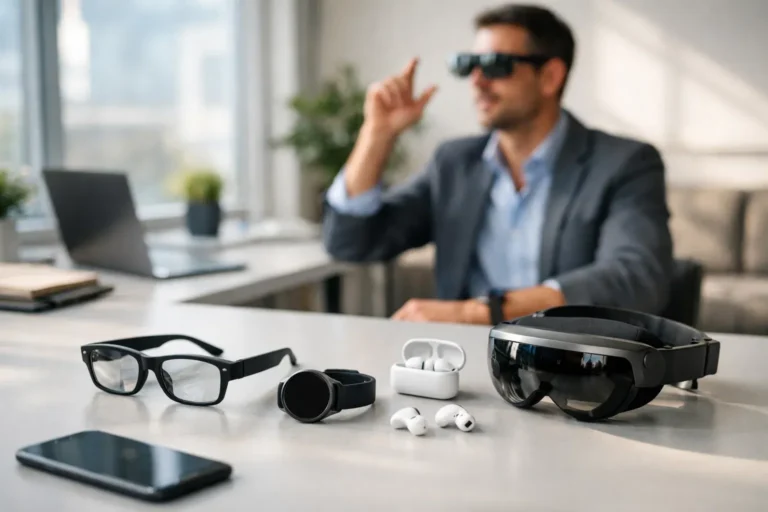

The wearable AI technology trends shaping 2026 are nothing short of a revolution. What was once a simple fitness band counting your steps has evolved into an intelligent, always-on health companion that predicts illness, coaches your performance, and augments your daily reality. Whether you are a tech enthusiast, a healthcare professional, or simply someone curious about the future of personal technology, this guide breaks down every major trend you need to know — with real devices, real data, and actionable insights.
By the end of this article, you will have a complete picture of where AI-powered wearables stand today, what breakthroughs are defining 2026, and how to choose the right device for your lifestyle.
Table of Contents
- Why 2026 Is a Turning Point for Wearable AI Technology
- Trend 1: AI-Powered Smart Rings — Health on Your Finger
- Trend 2: Predictive Health Smartwatches — Beyond Step Counting
- Trend 3: AI Smart Glasses & Augmented Reality Wearables
- Trend 4: Intelligent Hearables — Ears Are the New Interface
- Trend 5: Skin-Integrated Biosensors & Smart Patches
- Trend 6: AI Fitness & Wellness Coaching Wearables
- Trend 7: Neural Interface & Brain-Computer Wearables
- Data Privacy & Trust in AI Wearables
- How to Choose the Right AI Wearable in 2026
- Frequently Asked Questions
- Conclusion
Why 2026 Is a Turning Point for Wearable AI Technology
For years, wearables promised more than they delivered. Fitness bands counted steps. Smartwatches sent notifications. The “AI features” were mostly glorified averages. In 2026, that gap between promise and reality is finally closing — and three major forces are driving the shift.
1. AI Is Becoming Invisible Infrastructure
The most meaningful change in 2026 is that artificial intelligence is no longer marketed as a feature — it has become the invisible engine behind every function. Instead of announcing “AI-powered insights,” devices simply deliver results: personalized sleep scores, early arrhythmia warnings, and adaptive coaching that adjusts in real time. AI is the backend, not the headline.
2. Sensors Have Reached Clinical-Grade Accuracy
Advanced sensor engineering has pushed wearable devices into territory once reserved for hospital equipment. Modern smartwatches and smart rings now offer clinical-grade ECG monitoring, blood oxygen (SpO₂) measurement, skin temperature tracking, and early-stage blood pressure estimation. Some devices are moving toward non-invasive continuous glucose monitoring — a development that could transform diabetes management globally.
3. Edge Computing Enables Real-Time Intelligence
By processing data directly on the device rather than relying on cloud servers, wearables in 2026 deliver real-time insights with lower latency, reduced battery drain, and significantly stronger data privacy. This is the architecture shift that makes truly intelligent wearables possible.
Key Stat: According to industry research, 22% of firms are actively integrating AI into products and workflows — and wearable devices are at the forefront of this push.
Trend 1: AI-Powered Smart Rings — Health on Your Finger
Smart rings have quietly become one of the most impactful categories in the entire wearable technology landscape. Do not be fooled by the size — what these small devices pack in terms of sensor capability and AI intelligence is remarkable.
What Smart Rings Track in 2026
- Heart Rate Variability (HRV) — a key marker of recovery and stress
- Sleep stages — deep, REM, light, and awake periods tracked with high precision
- Blood oxygen (SpO₂) — continuous overnight monitoring
- Readiness scores — AI-generated daily scores that factor in multiple biometrics
- Early illness prediction — detecting elevated temperature and HRV changes before symptoms appear
- Early blood pressure estimation — emerging in newer models
Leading Smart Ring Brands in 2026
Oura Ring remains the market leader, with its AI health advisor (Oura Advisor) helping users understand trends across sleep, stress, and activity. The Samsung Galaxy Ring is gaining ground by integrating deeply with Samsung Health. Ultrahuman Ring Pro offers 15 days of battery life — addressing one of the most common wearable complaints. New entrants like Luna Band are offering premium, screen-free tracking without mandatory subscriptions, disrupting the traditional business model.
Why Smart Rings Matter for Semantic Search Intent
Users searching for “best wearable for sleep tracking” or “discreet health monitoring device” are increasingly landing on smart ring content. If your target audience values minimalist design, fashion-forward aesthetics, and 24/7 health data, smart rings are the trend to cover in depth.
Trend 2: Predictive Health Smartwatches — Beyond Step Counting
Smartwatches remain the cornerstone of the wearable AI technology market in 2026, but the category has evolved dramatically. The focus has shifted from reactive data to predictive intelligence.
What AI Smartwatches Predict Today
- Fatigue accumulation — alerting users before they experience performance decline
- Injury risk — flagging overtraining based on load and recovery data
- Sleep debt — calculating cumulative sleep deficit across multiple nights
- Cardiovascular strain trends — long-term heart health monitoring
- Arrhythmia detection — real-time ECG analysis with physician-grade alerts
Top Smartwatches Leading the 2026 Trend
Apple Watch Series (latest) continues to set the benchmark for health sensors and software integration. Samsung Galaxy Watch leverages Galaxy AI for deeper personalization. Garmin’s lineup is praised for exceptional battery life alongside its AI-powered fitness metrics. Meanwhile, Amazfit and Motorola are challenging premium brands by offering multi-week battery life at accessible price points — a significant CES 2026 talking point.
The Non-Invasive Glucose Monitoring Race
Perhaps the biggest breakthrough on the horizon is non-invasive blood glucose monitoring directly from the wrist. Multiple manufacturers are in advanced development. When this arrives at consumer-grade accuracy, it will redefine wearable health technology — particularly for the 537 million people living with diabetes worldwide.
Trend 3: AI Smart Glasses & Augmented Reality Wearables
Smart glasses technology is having its mainstream moment in 2026. After years of false starts and overhyped prototypes, AI-integrated eyewear has matured into a genuinely practical category.
How Smart Glasses Work in 2026
Modern AI smart glasses combine lightweight embedded processors, miniaturized cameras, directional microphones, and transparent displays. They respond to voice commands, translate text in real time, stream content hands-free, and — crucially — perform many functions independently without needing a connected smartphone.
Real-World Applications Across Industries
- Healthcare: Surgeons use AR overlays to view patient scans during procedures without looking away from the operating field
- Logistics & Warehousing: Workers get real-time inventory data and route optimization through their field of view
- Education: Teachers project interactive AR lessons; students explore immersive simulations
- Daily Use: Navigation arrows, real-time translation, hands-free content creation, and live streaming
Leading AI Smart Glasses in 2026
Meta Ray-Ban Smart Glasses continue to lead the consumer segment, with natural voice AI, real-time translation, and social media integration. Xreal Project Aura targets productivity users with virtual multi-window workspaces that appear in your surroundings — designed to look like standard sunglasses for social acceptance. These devices represent a post-screen era where digital information integrates naturally into physical reality.
Trend 4: Intelligent Hearables — Ears Are the New Interface
Earbuds and hearing devices have transformed from passive audio accessories into active health platforms. This is one of the fastest-growing segments of the wearable AI technology market.
What Intelligent Hearables Offer
- Real-time language translation in over 40 languages
- AI noise cancellation that adapts dynamically to your environment
- Biometric health monitoring (heart rate, body temperature) via the ear canal
- Cognitive load detection — identifying when you are mentally fatigued
- Voice-activated AI assistants with context awareness
The Hearing Aid Revolution
A remarkable development in 2026 is the convergence of hearing aids and health monitors. Modern hearing devices now function as 24/7 wellness companions — offering comfort alongside real-time biometric insights. This inclusive design makes powerful health AI accessible to seniors and people with hearing impairments, broadening the entire wearable market.
Trend 5: Skin-Integrated Biosensors & Smart Patches
Beyond wrist and finger devices, a new frontier of wearable AI is literally sticking to your skin. Smart patches and skin-integrated sensors represent the most discreet form of continuous health monitoring available today.
Current Capabilities of Smart Patches
- Continuous glucose monitoring — now consumer-accessible, not just clinical
- Sweat analysis — tracking lactate, sodium, and hydration levels for athletes
- Cardiac monitoring patches — extended ECG recording over days or weeks
- Medication delivery tracking — patches that log when and how much medication is absorbed
The PF Sweat Patch gained notable attention in 2026 as a health-focused device delivering personalized wellness data through sweat biomarker analysis. These tools blur the line between consumer wellness and clinical-grade diagnostics.
Trend 6: AI Fitness & Wellness Coaching Wearables
One of the most impactful shifts in wearable AI technology is the move from data collection to actionable AI coaching. In 2026, your wearable does not just tell you what happened — it tells you what to do about it.
How AI Coaching Works in Wearables
Generative AI embedded in wearable ecosystems creates adaptive, personalized guidance based on your actual biometric trends. Instead of generic advice like “walk 10,000 steps,” users receive context-aware recommendations: “Your HRV dropped 18% overnight — consider reducing workout intensity today and prioritizing sleep by 10 PM.” The guidance is specific, timed, and grounded in your own data.
Key Features of AI Coaching Wearables
- Adaptive training loads — workouts that adjust based on your recovery status
- Nutrition guidance — meal timing and hydration prompts tied to activity levels
- Mental wellness nudges — breathing exercises triggered when stress markers spike
- Sleep optimization coaching — personalised wind-down routines based on your patterns
AI note-taking wearables like the Plaud NotePin extend this coaching concept to productivity — automatically transcribing meetings, generating summaries, and creating action items from recorded conversations, worn as a discrete clip-on device.
Trend 7: Neural Interface & Brain-Computer Wearables
The most forward-looking category in wearable AI technology trends is neural interface devices — hardware that creates a direct communication channel between the human brain and digital systems.
Where Neural Wearables Stand in 2026
Neuralink has demonstrated brain-computer interface technology that enables individuals with paralysis to control digital devices through thought alone. While still in clinical and early consumer stages, this technology represents a paradigm shift in human-computer interaction. Non-invasive EEG headbands for focus and stress monitoring are already available to consumers, with AI interpreting brainwave patterns to deliver meditation guidance, focus scores, and cognitive performance insights.
Near-Term Applications
- Focus-enhancing wearables for productivity and studying
- Accessibility devices for individuals with motor impairments
- Mental health monitoring for clinical use
- Gaming and immersive experience control via thought
Note: Neural interface wearables raise important ethical questions around mental privacy and consent. Leading researchers emphasize that regulatory frameworks must evolve alongside the technology.
Data Privacy & Trust in AI Wearables
As wearable AI technology becomes more intimate — monitoring your heart, sleep, stress, and even your thoughts — data privacy is no longer optional. It is the foundation of consumer trust.
What Consumers Expect From Wearable Data Security in 2026
According to a 2026 Clutch survey, 87% of consumers are willing to pay more for wearable products from brands they trust. Trust is built on three pillars: accuracy, battery life, and data privacy.
Privacy Best Practices to Look For
- On-device (edge) processing — data stays on your device, not cloud servers
- End-to-end encryption — all transmitted data is encrypted
- Transparent data policies — clear explanations of what is collected and shared
- Compliance certifications — ISO 27001, HIPAA (healthcare), GDPR (Europe)
- User consent controls — granular settings for data sharing
When evaluating any AI wearable device, particularly one with always-on microphones or cameras, reviewing the manufacturer’s data security documentation is not optional — it is essential.
How to Choose the Right AI Wearable in 2026
With dozens of devices across multiple categories, choosing the right AI wearable can feel overwhelming. Use this framework to narrow down your options.
Step 1: Define Your Primary Use Case
- Health monitoring → Smart ring (Oura, Ultrahuman) or clinical-grade smartwatch
- Fitness coaching → Garmin, Apple Watch, or Samsung Galaxy Watch
- Productivity → AI smart glasses or Plaud NotePin
- AR / immersive experiences → Xreal Project Aura, Meta Ray-Ban
- Sleep optimization → Smart ring with dedicated sleep AI
Step 2: Consider Comfort and Form Factor
AI wearables are designed to be worn for extended periods — sometimes all day and night. Prioritize lightweight materials, skin-safe finishes, and a size that fits your lifestyle. A device with impressive features is useless if you stop wearing it after a week.
Step 3: Evaluate Battery Life
Devices requiring daily charging interrupt data collection and break behavioral patterns. In 2026, look for a minimum of 5 days of battery life for health-focused wearables. Smart rings like the Ultrahuman Ring Pro offer up to 15 days — making them genuinely hands-off health companions.
Step 4: Check Data Privacy Standards
As covered above, always verify the device’s data handling policies before purchase — particularly if you plan to use it for health-related monitoring.
Step 5: Look for Ecosystem Integration
The best AI wearables work within a connected ecosystem. A Samsung Galaxy Watch integrates deeply with Samsung Health and Galaxy phones. Apple Watch pairs natively with the Apple Health app. Consider which digital ecosystem you already live in before choosing your device.
Frequently Asked Questions About Wearable AI Technology Trends
What are the top wearable AI technology trends in 2026?
The top wearable AI technology trends in 2026 include AI-powered smart rings, predictive health smartwatches, augmented reality smart glasses, intelligent hearables, skin-integrated biosensors, generative AI fitness coaching wearables, and emerging neural interface devices.
How does AI improve wearable health monitoring in 2026?
AI improves wearable health monitoring by enabling real-time pattern recognition for early disease detection, predictive analytics for fatigue and injury risk, personalized health coaching, and clinical-grade accuracy in ECG, SpO₂, and blood pressure monitoring — all delivered in a wearable form factor.
Are AI wearables safe and private?
Most leading AI wearables in 2026 use on-device (edge) processing to minimize cloud dependency, which improves both speed and data privacy. Top brands comply with data protection standards like HIPAA, ISO 27001, and GDPR. Always review a manufacturer’s privacy policy before purchasing.
What is the best AI wearable device in 2026?
The best AI wearable depends on your use case. For health tracking and sleep, the Oura Ring and Samsung Galaxy Watch are top choices. For AR and productivity, Meta Ray-Ban smart glasses and Xreal Project Aura lead the market. For meeting transcription and note-taking, the Plaud NotePin is highly rated among professionals.
Will AI wearables replace doctors?
No — and the best AI wearable platforms are designed with this in mind. Tools like Oura Advisor are built to explain trends, connect data points, and help users understand their health patterns. They function as intelligent interpreters of your data, not replacements for medical professionals. However, they do enable earlier detection and more informed conversations with healthcare providers.
Conclusion: The Wearable AI Era Has Arrived
The wearable AI technology trends of 2026 represent a fundamental shift in how humans interact with their own health, performance, and environment. What began as novelty gadgets have matured into intelligent, clinical-grade companions that predict illness before symptoms appear, coach your fitness in real time, translate languages in your ear, and project digital workspaces in your field of vision.
The devices are no longer experimental — they are essential. Smart rings track your body while you sleep. AI glasses augment your world as you move through it. Predictive smartwatches catch cardiovascular risks before they become emergencies. And neural interfaces are beginning to dissolve the boundary between thought and action.
Whether you are looking to invest in your health, boost your productivity, or simply stay ahead of the technology curve, 2026 is the year to take wearable AI seriously. The intelligence is there. The form factors are refined. The data privacy standards are improving. All that remains is choosing the right device for your life.
You May Like This:
Tech Giants Envision Future Beyond Smartphones 2026: What Comes Next After Mobile Devices?
About the Author