
The term “AI robots” often brings to mind images from science fiction movies—walking, talking machines that are either humanity’s greatest ally or its biggest threat. For years, that’s mostly what they were: a concept. But as we move through 2026, I’ve seen firsthand how these intelligent machines have stepped out of the screen and into our reality. They are no longer a distant future; they are here, actively transforming how we work, heal, and live.
The integration of advanced artificial intelligence has turned what were once simple automated arms into thinking, learning partners. These AI robots are now capable of performing complex tasks with incredible precision and adaptability. This guide is designed to demystify this technology. We will explore what makes these robots tick, where you can find them today, and what their rapid evolution means for all of us.
Here’s what you can expect to learn:
- The core technologies that give AI robots their intelligence.
- The different types of robots and their real-world applications.
- The tangible benefits and the common mistakes to avoid when using them.
- A realistic look at the future and how to choose the right robot for your needs.
By the end, you’ll have a clear and comprehensive understanding of AI robots and their place in our modern world.
Quick Overview
AI robots are machines equipped with artificial intelligence, allowing them to learn from data, make decisions, and interact with their environment. Using technologies like machine learning and computer vision, these robots perform complex tasks autonomously in fields such as manufacturing, healthcare, and logistics, moving beyond simple pre-programmed automation.
Table of Contents
- How AI Robots Work: The Technology Behind the Machines
- Types of AI Robots
- Applications of AI Robots in 2026
- Benefits of AI Robots
- Common Mistakes When Using AI Robots
- AI Robots vs. Traditional Automation
- Pros and Cons of AI Robots
- Future Trends in AI Robotics
- How to Choose the Right AI Robot for Your Needs
- Real-Life Experiences with AI Robots
- Conclusion
- FAQs About AI Robots
How AI Robots Work: The Technology Behind the Machines
At a glance, an AI robot might look like any other machine. The real magic, however, lies in its “brain” and “senses.” Unlike a traditional robot that just follows a rigid set of commands, an AI robot can perceive its environment, process information, and make intelligent decisions on the fly.
The core of this intelligence comes from a few key technologies. Machine learning allows a robot to improve its performance over time by learning from data, much like a human learns from experience. Computer vision acts as the robot’s eyes, using cameras and sensors to identify objects, navigate spaces, and even recognize faces. Then there’s natural language processing (NLP), which enables some robots to understand and respond to human speech.
These software brains control the robot’s hardware. Sensors (like cameras, microphones, and lidar) gather data from the world. The AI processes this data using complex algorithms called neural networks, which are modeled after the human brain. Once a decision is made, it sends commands to actuators—the motors and joints that create physical movement. This entire process can happen on the device itself (edge AI) or by connecting to powerful servers (cloud computing).
Types of AI Robots
The world of AI robotics is incredibly diverse, with machines designed for a huge range of tasks. They can be broadly categorized based on their design and function. Understanding these categories helps clarify their specific roles.
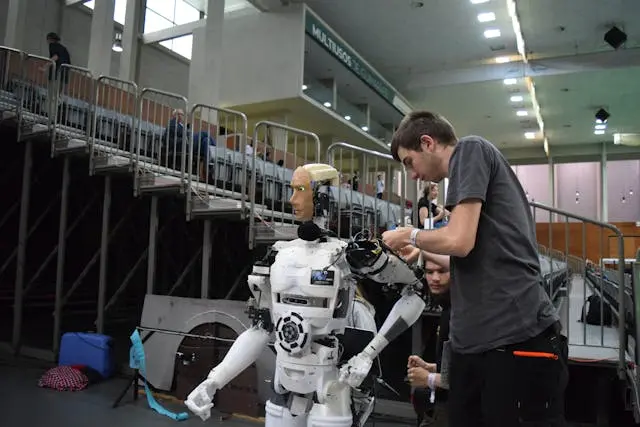
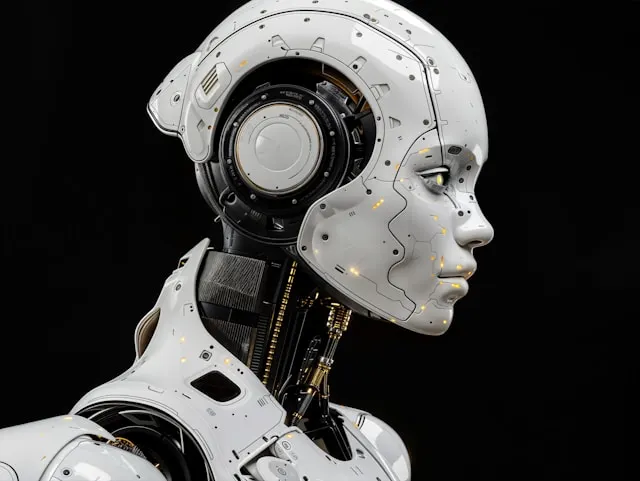
- Humanoid Robots: These are designed to resemble the human body. While they are complex and often expensive, humanoid robots excel in environments built for people. They can walk, climb stairs, and manipulate objects with hands, making them suitable for tasks like disaster response or as personal assistants.
- Industrial Robots: Often seen as large robotic arms, these are the workhorses of manufacturing. With AI, they’ve evolved from simply repeating one task to handling variations, performing quality checks, and working safely alongside humans (these are known as “cobots”).
- Service Robots: This is a broad category that includes robots designed to perform useful tasks for humans or businesses. Examples include delivery drones, cleaning robots in airports, and customer service bots in stores.
- Autonomous Robots: These robots operate completely independently without direct human control. They use their sensors and AI to navigate and complete goals. A warehouse robot that picks and moves inventory is a prime example of AI automation.
Robot Type | Key Features | Primary Use Cases | Autonomy Level |
|---|---|---|---|
Humanoid | Human-like form, bipedal motion | Research, public interaction, assistance | Semi to Fully Autonomous |
Industrial | High precision, strength, speed | Manufacturing, assembly, welding | Pre-programmed to Autonomous |
Service | Task-specific design | Logistics, cleaning, customer service | Semi to Fully Autonomous |
Autonomous | Self-navigating, decision-making | Delivery, exploration, security | Fully Autonomous |
Applications of AI Robots in 2026
The practical applications of AI robots have exploded in recent years. They are no longer just in factories but are becoming integral to many sectors of the US economy and daily life.
In healthcare, I’ve seen surgical robots assist surgeons with superhuman precision, leading to less invasive procedures and faster recovery times. In elder care facilities, companion robots are helping combat loneliness and assisting with daily reminders.
Manufacturing has been revolutionized. Instead of just welding car doors, AI robots now use computer vision to inspect parts for microscopic defects, predict when a machine needs maintenance, and adjust their own processes for better efficiency. This level of AI automation is a game-changer.
In retail and hospitality, you might see a robot guiding you to a product in a large hardware store or delivering room service in a hotel. Behind the scenes, autonomous robots are managing vast warehouses for e-commerce giants, ensuring your packages arrive on time. Even our homes are getting smarter, with advanced robotic vacuums that map rooms and avoid obstacles intelligently.
Benefits of AI Robots
The adoption of AI robots brings a host of powerful advantages for businesses, individuals, and society as a whole. The most immediate benefit is a dramatic increase in efficiency and productivity. A robot doesn’t need breaks, vacations, or sleep, allowing for 24/7 operation in industries like manufacturing or logistics.
This leads directly to long-term cost savings. While the initial investment can be high, the robot’s continuous operation and lower error rates often result in a strong return. Accuracy is another key benefit. For tasks requiring extreme precision, like assembling electronics or performing surgery, an AI robot can perform with a level of consistency that is difficult for a human to match.
Perhaps most importantly, AI robots enhance safety. They can take on jobs in hazardous environments—handling dangerous chemicals, working at extreme temperatures, or lifting dangerously heavy loads. In my experience, this is one of the most compelling reasons for adoption, as it directly reduces workplace accidents and protects human lives.
Common Mistakes When Using AI Robots
Adopting new technology always comes with a learning curve, and AI robots are no exception. One of the most common mistakes I’ve noticed is overestimating their capabilities. People sometimes expect a robot to be a perfect, thinking replacement for a human, but current AI still has limitations. They are powerful tools for specific tasks, not general-purpose problem solvers.
Another major pitfall is ignoring ethical considerations and data privacy. A robot equipped with cameras and microphones is also a data-gathering device. It’s crucial to have clear policies on what data is collected and how it’s used, especially for robots interacting with customers or patients. Failing to do so can lead to serious trust and legal issues.
Finally, poor maintenance is a frequent problem. This includes both the physical hardware and, more importantly, the software. Like any computer, AI robots need regular updates to patch security vulnerabilities and improve performance. Neglecting these updates can leave the robot inefficient and, in some cases, insecure.
AI Robots vs. Traditional Automation
It’s important to distinguish between AI robots and the traditional automation that has been used in factories for decades. A traditional robot is pre-programmed to do one thing over and over again with no deviation. If a part is misplaced on the assembly line, the robot will continue its task, potentially causing an error.
An AI robot, on the other hand, is adaptable. Using its sensors and AI, it can recognize the misplaced part, adjust its own position to pick it up correctly, or even alert a human supervisor to the problem. This ability to perceive, learn, and adapt is the key difference.
- Flexibility: Traditional robots require extensive reprogramming for new tasks. AI robots can often learn new tasks through demonstration or simulation.
- Decision-Making: Traditional robots follow a script. AI robots make real-time decisions based on changing environmental data.
- Scalability: While both are scalable, AI systems can improve their collective intelligence over time as more data is gathered, a feature traditional systems lack.
In essence, traditional automation is about repetition, while artificial intelligence robots are about adaptation.
Pros and Cons of AI Robots
Like any transformative technology, AI robots come with a balanced set of pros and cons. It’s essential to look at the full picture.
Pros:
- Increased Efficiency and Productivity: They can work faster, longer, and with fewer errors than humans in many repetitive tasks.
- Enhanced Safety: They can operate in environments that are dangerous or unhealthy for people.
- Innovation: They push the boundaries of what’s possible in medicine, exploration, and science.
- Reduced Labor Costs: Over the long term, automation can be more cost-effective for certain roles.
Cons:
- High Initial Cost: The investment in advanced robotic systems can be substantial.
- Job Displacement: There are legitimate concerns about AI and automation replacing human jobs, requiring societal adaptation and workforce retraining.
- Ethical Dilemmas: Questions about accountability, bias in AI decision-making, and the use of autonomous weapons are still being debated.
- Technical Complexity: These systems require specialized knowledge to install, maintain, and repair.
From what I’ve seen, successful implementation involves using robots to augment human capabilities, not just replace them, which helps mitigate some of the cons.
Future Trends in AI Robotics
The field of AI robotics is evolving at a breathtaking pace. Looking ahead, several trends are set to define the next generation of these intelligent machines. One of the most exciting is the rise of swarm robotics, where groups of simpler, cheaper robots collaborate to perform complex tasks, like mapping a disaster area or managing a farm.
We are also seeing deeper integration with the Internet of Things (IoT). Your home cleaning robot might soon get information from your smart calendar to know when you’re out of the house, and industrial robots will communicate with every other machine in the factory to create a truly seamless, self-optimizing system.
Personalized healthcare is another major frontier. Imagine a future where a small robot in your home can perform routine health checks, dispense medication, and provide real-time data to your doctor. Finally, a strong push toward ethical AI is shaping development. The goal is to build robots that are not only intelligent but also fair, transparent, and aligned with human values.
How to Choose the Right AI Robot for Your Needs
Whether you’re a business owner or an individual, selecting the right AI robot requires careful consideration. The first step is to clearly define its purpose. What specific task do you need it to perform? A robot designed for warehouse logistics is very different from one designed for customer interaction.
Cost is obviously a major factor, but it’s important to think beyond the initial purchase price. Consider the total cost of ownership, which includes maintenance, software updates, and any necessary training for your staff. Scalability is also key. Will you be able to update the robot’s capabilities or add more units to your system as your needs grow?
Finally, evaluate the vendor’s reputation for reliability and support. What works best is choosing a partner who offers robust technical support and a clear roadmap for future software and hardware improvements. Creating a checklist of your needs before you start shopping is an invaluable step in making the right choice.
Real-Life Experiences with AI Robots
The true impact of AI robots is best understood through real stories. I recently spoke with a factory manager who implemented “cobots” (collaborative robots) on their assembly line. He said productivity on that line increased by 30%, but more importantly, worker injuries from repetitive strain dropped to zero. The robots handled the strenuous lifting while the human workers performed the more delicate final assembly and quality checks.
In a different context, a friend of mine whose elderly father lives alone purchased a personal assistant robot. He was initially skeptical, but now he says it’s been a blessing. The robot reminds his father to take his medication, facilitates video calls with family, and can detect a fall and automatically alert emergency services. It provides a layer of safety and connection that has given the whole family peace of mind. These stories show that when applied thoughtfully, this technology has a profound, positive human impact.
Conclusion
AI robots have firmly moved from the realm of theory to practical, impactful reality. In 2026, they are more than just tools; they are becoming partners that enhance our safety, boost our productivity, and open doors to innovations we could only dream of a decade ago. From the precision of a surgical bot to the tireless work of a warehouse automaton, these intelligent machines are reshaping our world in countless positive ways.
Of course, this powerful technology comes with responsibilities. The conversations around job displacement, ethics, and data privacy are not just important—they are essential. The most successful adoptions I’ve witnessed are those where AI robots are used to empower people, taking over the dull, dangerous, and dirty jobs so that we can focus on what humans do best: creativity, critical thinking, and emotional connection.
My final advice is to approach this technology with open-minded curiosity:
- Understand that they are specialized tools, not all-knowing beings.
- Start small and focus on solving a specific, tangible problem.
- Prioritize ethical considerations and data security from day one.
- View AI robots not as a replacement for humans, but as collaborators.
The journey with AI robotics is just beginning. By embracing it responsibly, we can ensure that these intelligent machines help us build a smarter, safer, and more efficient future for everyone.
FAQs About AI Robots
What are AI robots and how do they differ from normal robots?
An AI robot is a machine enhanced with artificial intelligence. While a normal robot follows a fixed set of pre-programmed instructions, an AI robot can perceive its environment using sensors, learn from data, and make autonomous decisions to adapt to new situations.
Can AI robots replace human jobs entirely?
While AI robots and automation will certainly transform the job market, they are unlikely to replace human jobs entirely. They excel at repetitive, structured, or dangerous tasks. This shift will likely move human workers toward roles that require creativity, complex problem-solving, and emotional intelligence—skills that AI currently cannot replicate.
How much does an AI robot cost in 2026?
The cost varies dramatically. A consumer-grade robotic vacuum might cost a few hundred dollars. A commercial collaborative robot (“cobot”) for a factory can range from $20,000 to $100,000. Advanced humanoid robots or surgical systems can cost millions. Prices are steadily decreasing as the technology matures.
Are AI robots safe for home use?
Yes, consumer-grade AI robots are designed with safety as a top priority. They are equipped with numerous sensors to avoid collisions with people, pets, and furniture. However, like any smart device, it’s crucial for users to follow security best practices, such as using strong passwords, to protect their data.
What industries benefit most from AI robots?
Manufacturing, logistics, and healthcare are currently seeing the biggest benefits. Manufacturing gains efficiency and precision, logistics uses them for warehouse automation, and healthcare leverages them for surgery and patient care. However, agriculture, retail, and hospitality are also adopting them rapidly.
How do AI robots learn and improve over time?
AI robots learn through a process called machine learning. They are “trained” on vast datasets, allowing them to recognize patterns. They can also learn from experience through reinforcement learning, where the robot is rewarded for successful outcomes, helping it refine its strategies over time.
What ethical issues surround AI robotics?
Key ethical issues include potential job displacement, algorithmic bias (where AI makes unfair decisions based on flawed data), data privacy concerns from sensors, and accountability (who is responsible if an autonomous robot makes a mistake?). There are also ongoing debates about the use of AI in autonomous weapons systems.
About the Author