Introduction to Robotics Technology
It feels like just yesterday that robots were the stuff of sci-fi movies, clanking around in metal suits. But look around in 2026, and you’ll see that robotics technology explained simply is no longer a futuristic concept—it’s the reality of our daily lives. From the warehouse bots that speed up your overnight deliveries to the subtle automated systems in your car, robotics has quietly revolutionized how we live and work.
Understanding this technology isn’t just for engineers or coding wizards anymore. Whether you are a student curious about a future career, a professional looking to upskill, or just someone who wants to know how that smart vacuum actually “sees” your cat, this guide is for you. In my experience, breaking down these complex systems into simple parts makes them far less intimidating and much more fascinating.
In this guide, you will learn:
- The fundamental components that make up any robot.
- How machines actually “think” and make decisions.
- The crucial differences between simple automation and true robotics.
- Real-world examples of how robotics is shaping the future in the USA and UK.
Quick Overview – AI Summary
Robotics technology is the branch of engineering and science that involves designing, building, and operating robots. It combines mechanical parts, sensors, and computer programming to create machines that can perform tasks automatically. Unlike simple machines, robots can sense their environment, process information, and make decisions to complete actions without constant human help.
Table of Contents
- Introduction to Robotics Technology
- What Is Robotics Technology? (Simple Explanation)
- Core Components of Robotics Technology
- How Robotics Technology Works Step by Step
- Robotics Technology Basics for Beginners
- Real-Life Applications of Robotics Technology
- Robotics Technology in Everyday Life
- Pros and Cons of Robotics Technology
- Common Mistakes and Misconceptions About Robotics
- Robotics vs Artificial Intelligence vs Automation
- Future of Robotics Technology (2026 and Beyond)
- Conclusion
- Frequently Asked Questions (FAQs)
What Is Robotics Technology? (Simple Explanation)
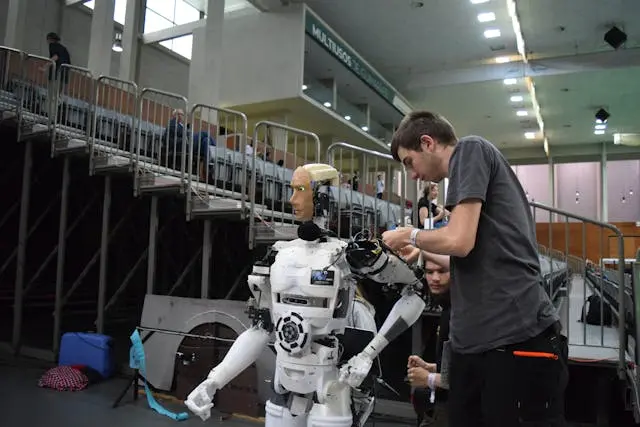
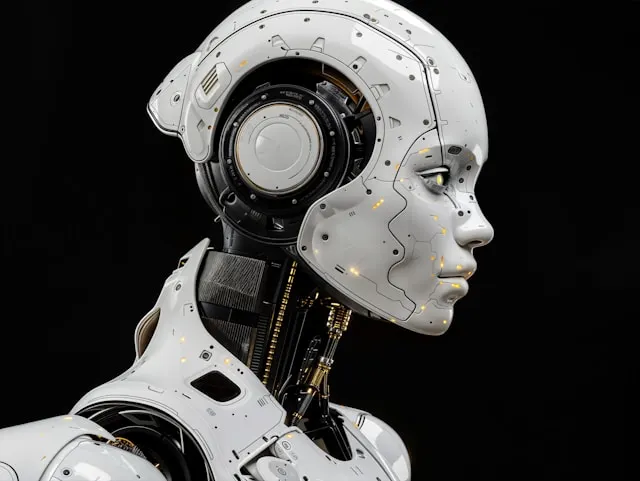
At its core, robotics technology is the intersection of engineering, science, and technology dedicated to creating machines that can help humans. When I explain this to friends, I often say that if a computer is a brain in a box, a robot is a computer with a body. It’s not just about metal and wires; it’s about giving a machine the agency to interact with the physical world.
This field doesn’t stand alone. It is a melting pot of disciplines—mechanical engineering builds the body, electrical engineering powers the nerves, and computer science provides the brain. This combination allows robots to do things that traditional machines cannot, such as adapting to a changing environment or performing delicate tasks with precision.
Here is the easiest way to break it down:
- Hardware + Software + Intelligence: A robot needs a physical body, code to run it, and logic to make decisions.
- Sensing and Acting: Unlike a toaster that just heats up, a robot senses the bread, decides when it’s done, and pops it up.
- Versatility: Traditional automation repeats one motion forever; robotics technology allows machines to be reprogrammed for different tasks.
Core Components of Robotics Technology
To understand robotics technology explained thoroughly, you have to look under the hood. Every robot, whether it’s a giant arm in a car factory or a tiny medical bot, is built from the same fundamental building blocks. These components work together in harmony to bring the machine to life.
Just like a human body has bones, muscles, senses, and a brain, a robot has equivalent systems. If you take away any one of these parts, the robot ceases to function effectively.
- Mechanical Structure: This is the robot’s “skeleton.” It includes the chassis, arms, wheels, and joints that give the robot its shape and allow it to physically move or hold objects.
- Sensors: These are the eyes and ears. Sensors allow the robot to gather data from its surroundings—cameras for vision, microphones for sound, and proximity sensors to avoid bumping into walls.
- Controllers: The “brain” of the operation. Usually a small computer or microcontroller, this part processes the data from the sensors and tells the robot what to do next.
- Actuators: Think of these as the muscles. Actuators are the motors, pistons, and servos that actually move the mechanical structure based on commands from the controller.
- Power Source: The heart that pumps energy. This could be a lithium-ion battery for a mobile robot or a direct electrical connection for stationary industrial arms.
How Robotics Technology Works Step by Step
The workflow of a robot is surprisingly similar to how humans react to the world. When I teach beginners, I liken it to catching a ball: your eyes see it (input), your brain calculates the trajectory (processing), and your arm moves to catch it (output). Robotics follows this same “Sense-Think-Act” cycle.
It starts with the input phase. The robot is constantly scanning its environment using its sensors. This data is raw and needs interpretation—like a stream of numbers representing distance or color.
Here is the step-by-step flow:
- Sensors collect data: Cameras or infrared sensors detect an obstacle or a target object.
- Data sent to controller: This raw information travels to the robot’s central processor.
- Software processes information: Algorithms analyze the data to understand what is happening (e.g., “There is a wall 10 cm ahead”).
- Decision-making logic applied: The code determines the best response based on pre-set rules or AI (e.g., “Stop and turn left”).
- Actuators perform actions: The controller sends electrical signals to the motors to execute the turn.
Robotics Technology Basics for Beginners
Entering the world of robotics can feel overwhelming because of the jargon, but you don’t need a PhD to get started. In my experience, the biggest barrier is the fear that it’s “too math-heavy.” While advanced robotics involves complex calculus, the basics are grounded in logic and creativity.
The entry points for learning are more accessible than ever. You can start by understanding simple logic flows—if X happens, then do Y. This is the foundation of all robotic behavior.
Key concepts for beginners include:
- Programming Basics: You don’t need to master C++ immediately. Block-based coding (like Scratch) is often used to teach the logic of robotic commands.
- Algorithms: These are just step-by-step recipes for solving a problem. A robot follows an algorithm to navigate a maze.
- AI vs. Traditional Robotics: Beginners should know that not all robots have “artificial intelligence.” Many just follow a fixed script.
- Beginner Tools: Kits like LEGO Mindstorms or Arduino starter sets are fantastic for grasping the conceptual link between code and physical movement without needing to solder wires.
Real-Life Applications of Robotics Technology
We often think of robots as futuristic companions, but they are already the invisible workforce powering our modern economy. Robotics technology has permeated almost every major industry, increasing efficiency and safety in ways we often take for granted.
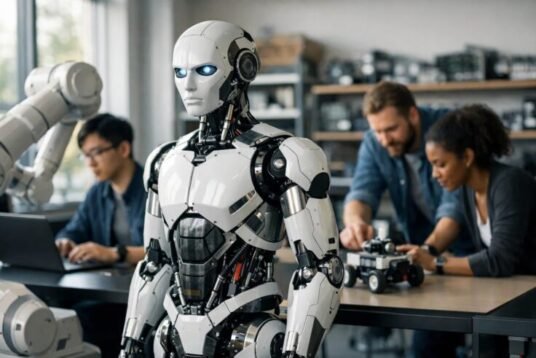
In manufacturing, the image of a human tightening bolts on an assembly line is fading. Today, “cobots” (collaborative robots) work alongside humans to handle dangerous or repetitive tasks with perfect precision. This shift has redefined productivity in factories across the US and UK.
Sectors heavily relying on robotics include:
- Manufacturing & Factories: Welding, painting, and assembly are now dominated by high-speed robotic arms.
- Healthcare & Surgery: Robots like the Da Vinci system allow surgeons to perform minimally invasive procedures with steady hands that never shake.
- Logistics & Warehouses: If you’ve ever wondered how your package arrives so fast, thank the autonomous mobile robots (AMRs) that sort and fetch goods in massive fulfillment centers.
- Agriculture & Farming: Automated drones monitor crop health, while robotic harvesters pick soft fruits without bruising them.
- Home Robotics: Beyond vacuums, we now have robotic lawnmowers and pool cleaners handling domestic chores.
Robotics Technology in Everyday Life
You might think you don’t interact with robots, but if you look closely, they are woven into the fabric of your day. I’ve noticed that people tend to ignore “invisible” robotics because the technology works so seamlessly. It doesn’t look like a humanoid robot, so we don’t register it as one.
Consider the smart vacuum cleaner. It maps your living room, avoids the stairs, and returns to its dock to charge. That is a sophisticated autonomous robot right in your home.
Other examples you might miss:
- Traffic Control Systems: Smart traffic lights use sensors and logic to adjust timing based on traffic flow—an automated robotic system managing city infrastructure.
- Automated Checkout Systems: The kiosk that scans your items and accepts payment is a form of stationary service robotics.
- Voice Assistants: While primarily software, devices like Alexa or Google Home are often the “interface” for wider home automation and robotic systems, controlling lights, locks, and blinds.
Pros and Cons of Robotics Technology
Like any transformative technology, robotics brings incredible benefits but also valid concerns. It is important to have a balanced view. I always tell enthusiasts that understanding the downsides is just as important as celebrating the innovations.
Pros:
- Increased Efficiency and Accuracy: Robots don’t get tired, distracted, or bored. They perform tasks with the same precision at 5 PM as they did at 9 AM.
- Reduced Human Risk: We can send robots into fires, deep oceans, or radioactive zones, keeping human workers safe from harm.
- 24/7 Operations: In industries like logistics, robots enable round-the-clock productivity without the need for sleep.
- Long-Term Cost Savings: While expensive upfront, robots often pay for themselves by reducing waste and errors over time.
Cons:
- High Initial Cost: The price tag for industrial robots and their installation can be prohibitive for small businesses.
- Job Displacement: There is a genuine fear that automation replaces low-skilled labor, requiring society to rethink workforce training.
- Maintenance Complexity: When a robot breaks, you need a specialized technician to fix it, which can cause costly downtime.
- Ethical and Security Risks: Hacking a robot or using autonomous weapons raises serious moral and safety questions.
Common Mistakes and Misconceptions About Robotics
There is a lot of misinformation out there. If you search for robotics technology explained, you often find articles that confuse robots with general AI or sci-fi movie tropes. Let’s clear up some of the most common myths I hear.
One major error is assuming every robot is “smart.” In reality, the vast majority of robots in the world are “dumb” machines that simply repeat a programmed motion. They don’t know what they are holding; they just know to close their gripper at a specific coordinate.
- Robots are not always AI-powered: A remote-controlled car is a robot, but it has no intelligence. It relies entirely on human input.
- Robotics ≠ Human Replacement: The goal of modern robotics is often collaboration (cobots), enhancing human capabilities rather than just replacing the person.
- Robots don’t “think” like humans: Even advanced AI robots don’t have consciousness or feelings. They are processing data, not experiencing the world.
- Math isn’t the only barrier: You can start learning robotics with logic and creativity. You don’t need to be a calculus expert to build your first working bot.
Robotics vs Artificial Intelligence vs Automation
This is where things get tricky for many beginners. These three terms—Robotics, AI, and Automation—are often used interchangeably, but they are distinct concepts. I like to think of them as a Venn diagram where they overlap but serve different functions.
Robotics is about the body. It deals with physical machines interacting with the physical world. A robot arm is robotics.
AI is about the brain. It deals with computer systems capable of performing tasks that typically require human intelligence, like recognizing speech or making decisions.
Automation is about the process. It is the technique of making a system operate automatically.
Here is how they compare:
- Robotics: The physical hardware (sensors, motors, arms).
- AI: The decision-making intelligence (learning from data, adapting).
- Automation: The rule-based execution (doing task X every time Y happens).
Modern systems often combine all three. An autonomous car is a robot (physical car) that uses AI (to navigate traffic) to achieve automation (driving you to work).
Future of Robotics Technology (2026 and Beyond)
As we look toward the latter half of the 2020s, the trajectory of robotics is shifting from simple automation to intelligent autonomy. In 2026, we are seeing robots move out of the cages in factories and into our daily spaces.
One major trend is the rise of general-purpose humanoid robots. Companies are racing to build bots that can navigate a house as easily as a human, folding laundry one minute and doing dishes the next.
Key trends to watch include:
- AI-Powered Autonomous Robots: Machines that can learn new tasks on the fly without being explicitly programmed for every movement.
- Human-Robot Collaboration: Workplaces where humans and robots share the same space safely, with robots handling the heavy lifting and humans handling the complex dexterity.
- Medical Robotics Growth: Nano-bots capable of delivering medicine inside the body are moving from research to reality.
- Smart Cities: Trash-collecting robots and autonomous public transport becoming standard infrastructure.
- Ethical Regulations: As robots become more common, governments in the UK and USA are drafting stricter laws on safety and liability.
Conclusion
Robotics technology is no longer a distant wave on the horizon—it has already reached the shore. From the intricate logic of controllers to the mechanical strength of actuators, understanding robotics technology explained simply gives you a new lens through which to view the world. It is a field that combines the best of human ingenuity with the precision of machines.
In my experience, the best way to predict the future is to understand the tools building it. Whether you are worried about job displacement or excited about the convenience of a robotic butler, knowledge is your best asset. Robotics is not just a booming industry; it is a fundamental shift in how we interact with our environment.
Key Takeaways:
- Robotics combines hardware (body), software (brain), and sensors (senses).
- It is distinct from AI, though the two often work together.
- The field offers massive career opportunities in healthcare, manufacturing, and tech.
- You don’t need to be a math genius to start learning the basics today.
- The future will focus on human-robot collaboration, not just replacement.
If you have ever felt a spark of curiosity about how things work, I encourage you to pick up a starter kit or take an online coding class. The world of robotics is waiting for you to build it.
Frequently Asked Questions (FAQs)
What is robotics technology in simple words?
Robotics technology is the field of designing and building machines (robots) that can perform tasks automatically. It involves combining mechanical parts, sensors, and computer code to create a machine that can sense its surroundings, think about what to do, and then act on it to help humans.
How does robotics technology work?
It works through a cycle of “Sense, Think, Act.” First, sensors (like cameras) collect data from the environment. Second, a controller (computer) processes that data using software logic. Finally, actuators (motors) move the robot’s parts to perform a physical action based on that decision.
Is robotics technology hard to learn for beginners?
Not necessarily. While professional engineering is complex, the basics are very accessible. Beginners can start with visual block coding and simple kits that require no soldering. The core concepts are based on logic and problem-solving, which anyone can learn with practice.
What skills are needed to learn robotics?
To start, you need curiosity and logical thinking. As you advance, useful skills include computer programming (Python or C++), basic electronics (understanding circuits), mechanical design, and mathematics (algebra and geometry).
What is the difference between robotics and AI?
Robotics is about the physical machine—the hardware that moves. AI (Artificial Intelligence) is the software “brain” that allows a computer to learn and make decisions. A robot can exist without AI (like a remote-control car), and AI can exist without a robot (like ChatGPT), but they are powerful when combined.
Where is robotics technology used the most?
Currently, it is most heavily used in manufacturing (automotive assembly), logistics (warehouse sorting), and healthcare (surgical robots). However, it is rapidly growing in agriculture, service industries, and domestic home use.
Is robotics a good career choice in 2026?
Absolutely. The demand for robotics engineers, technicians, and maintenance staff is at an all-time high in the USA and UK. As industries automate more processes, the need for skilled professionals to design, build, and fix these systems will continue to grow significantly.
About the Author